Over the last century and a half, human life expectancy has increased by nearly 50 years. That’s one of the greatest achievements in modern history.
But here’s the uncomfortable truth:
Living longer does not automatically mean living better.
Many people reach their 60s, 70s, and 80s managing chronic inflammation, declining mobility, slower recovery, brain fog, and metabolic dysfunction. The real challenge of longevity isn’t lifespan — it’s healthspan.
So why does the body begin to decline just as we gain more years?
The answer may lie in our biology.
For millions of years, human evolution prioritized survival through reproductive age. Once we moved beyond our prime reproductive years, long-term tissue repair and cellular regeneration were no longer evolutionary priorities.
This is where stem cells enter the conversation.
Stem cells are the body’s internal repair system. They help:
• Replace damaged tissue
• Repair organs
• Support recovery from injury
• Maintain cellular resilience
• Reduce inflammatory stress
When we’re young, stem cell activity is robust. The body efficiently repairs daily wear and tear. Cuts heal faster. Muscles recover quicker. Energy is abundant.
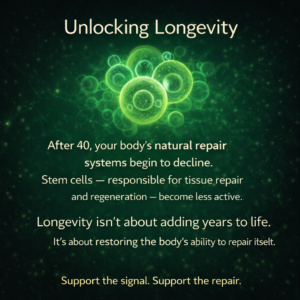
But around age 40, something shifts.
Research suggests that circulating stem cell numbers begin to decline. Their ability to mobilize and migrate toward damaged tissue becomes less efficient. Inflammation increases. Cellular signaling becomes noisier.
The body doesn’t suddenly break. It simply becomes less efficient at repair.
And aging, at its core, is the gradual loss of regenerative capacity.
This reframes longevity entirely.
Instead of chasing surface-level anti-aging solutions, the deeper question becomes:
How do we support the body’s natural repair systems?
Emerging longevity science focuses on enhancing stem cell release, improving cellular signaling, and reducing systemic inflammation — sometimes described as lowering “biological noise.”
Because stem cells rely on biochemical signals to locate tissues in need of repair. When inflammation rises, cytokines increase. That creates interference. And interference reduces efficiency.
Improving the signal-to-noise ratio in the bloodstream may allow stem cells to function more effectively.
This doesn’t mean introducing foreign cells into the body.
It means supporting what already exists.
Practical longevity strategies include:
• Reducing chronic inflammation through diet
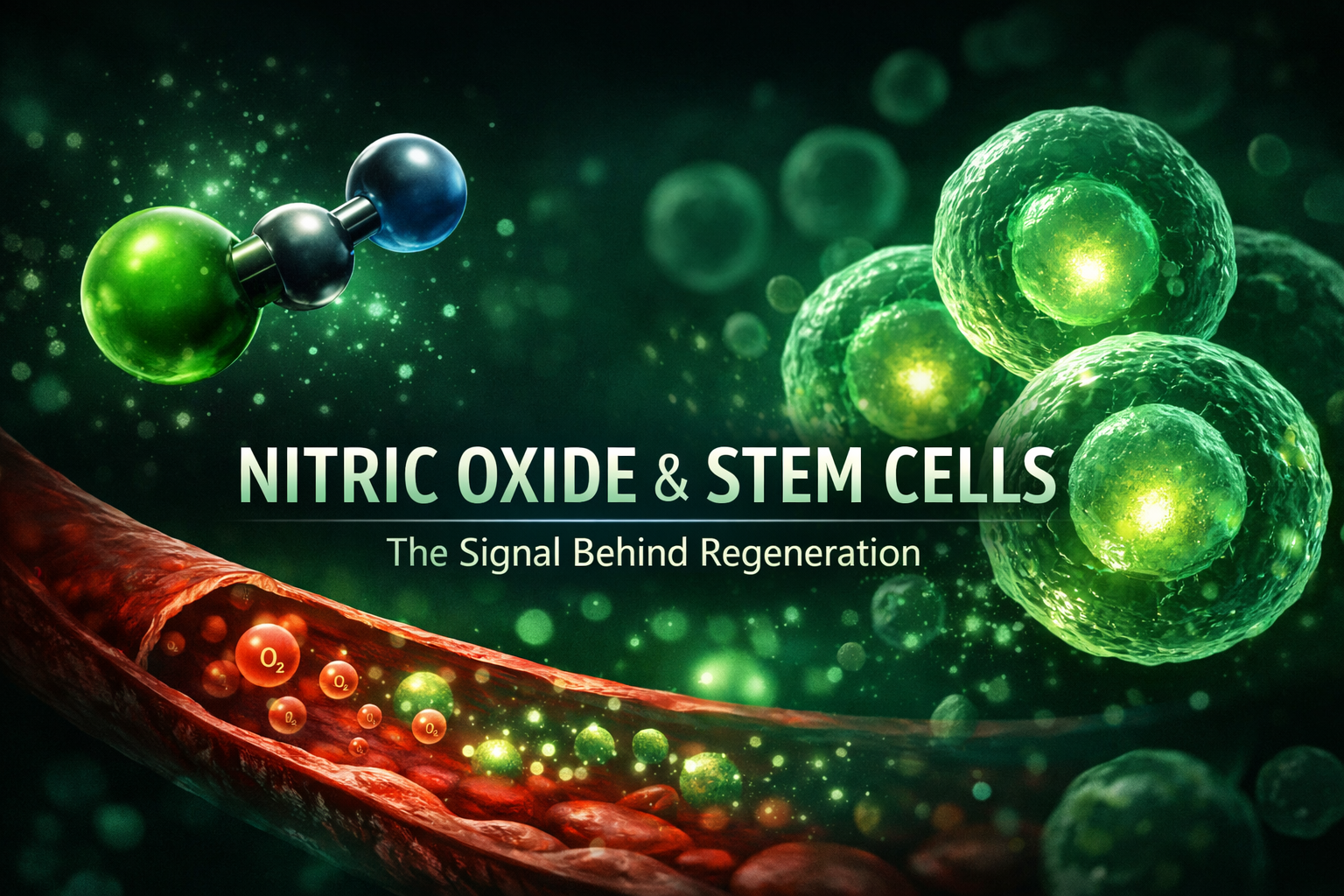
• Supporting nitric oxide production for circulation
• Maintaining mineral balance
• Detoxifying heavy metals
• Supporting gut health
• Optimizing sleep cycles
Longevity isn’t about extreme interventions.
It’s about restoring internal communication.
The future of healthy aging may not be about extending life indefinitely.
It may simply be about preserving the body’s ability to repair itself.
Because longevity isn’t adding years to life.
It’s adding life to years.
And the key may already be inside you.