When people talk about stem cells, they often focus on the cells themselves.
But few talk about the environment that allows stem cells to move, communicate, and repair tissue effectively.
One of the most overlooked molecules in that process?
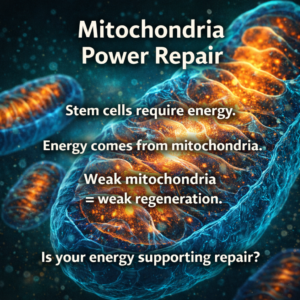
Nitric oxide.
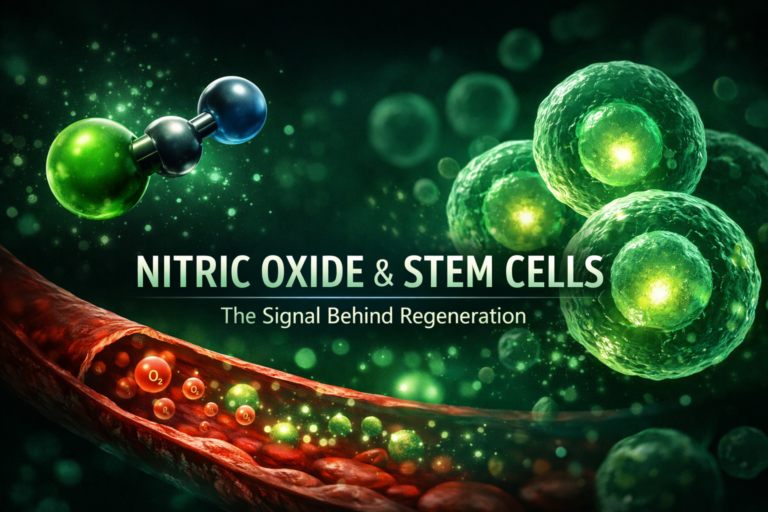
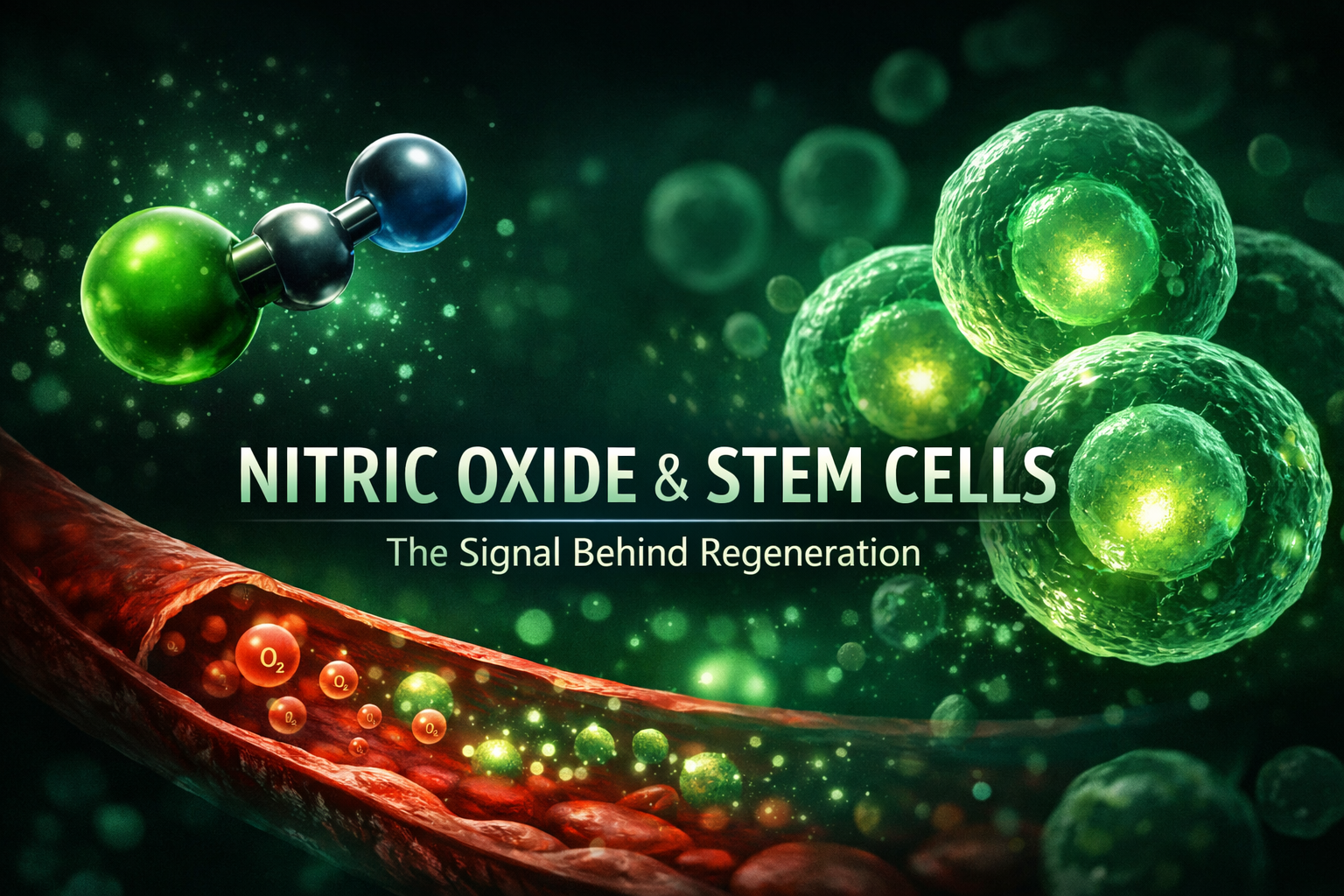
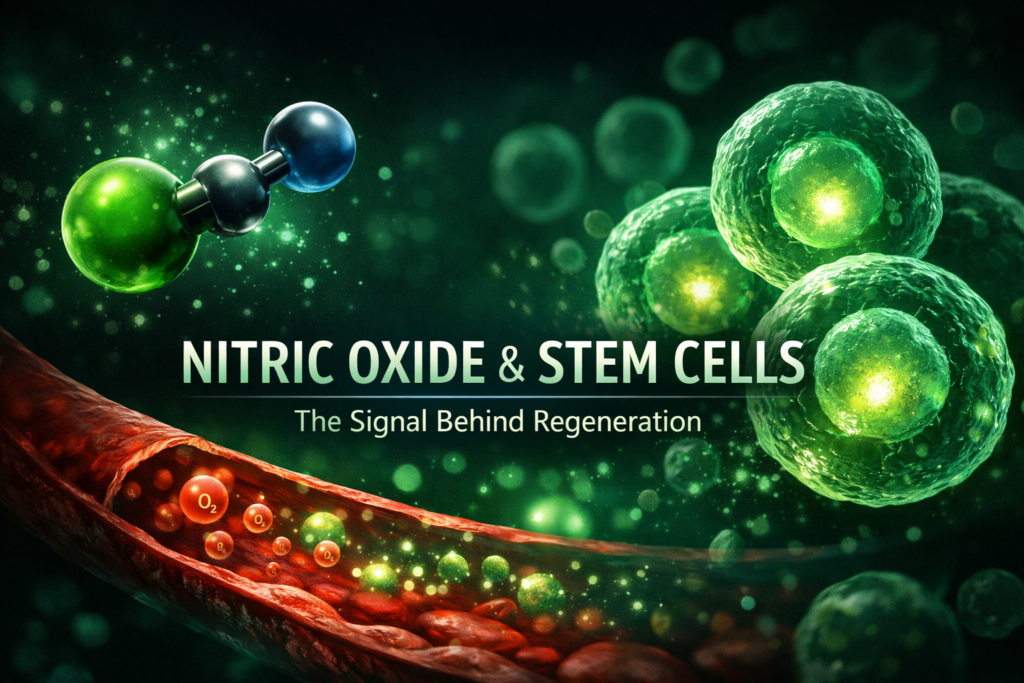
Nitric oxide (NO) is a signaling molecule your body produces naturally. It plays a critical role in vascular health, circulation, and cellular communication — all of which directly influence stem cell mobilization.
If stem cells are the repair crew…
Nitric oxide helps clear the roads and send the signal.
What Is Nitric Oxide?
Nitric oxide is a gas produced by the lining of your blood vessels (the endothelium). It acts as a vasodilator, meaning it relaxes and widens blood vessels.
This widening improves:
- Blood flow
- Oxygen delivery
- Nutrient transport
- Waste removal
According to research published in Circulation, nitric oxide is essential for maintaining vascular health and proper endothelial function.¹
Without adequate nitric oxide, blood vessels become less flexible — and circulation efficiency declines.
Why Circulation Matters for Stem Cells
Stem cells don’t teleport to injured tissue.
They travel through the bloodstream.
For stem cells to reach areas of inflammation or injury, the following must occur:
- Proper signaling from damaged tissue
- Mobilization of stem cells into circulation
- Efficient blood flow to target areas
- Adhesion and migration into tissue
Nitric oxide plays a role in multiple steps of this process.
Research published in Nature Medicine demonstrated that nitric oxide synthase (eNOS) is required for mobilization of progenitor cells from bone marrow.²
In simple terms:
Low nitric oxide = impaired mobilization.
Nitric Oxide and Aging
Nitric oxide production naturally declines with age.
Studies show endothelial function becomes less efficient over time, leading to reduced nitric oxide availability.³
This decline contributes to:
- Reduced vascular flexibility
- Slower tissue repair
- Decreased exercise capacity
- Impaired regenerative signaling
At the same time, stem cell activity also declines with age.
That overlap is not coincidence.
Circulation and regenerative potential are deeply connected.
Inflammation, Oxidative Stress, and “Signal Noise”
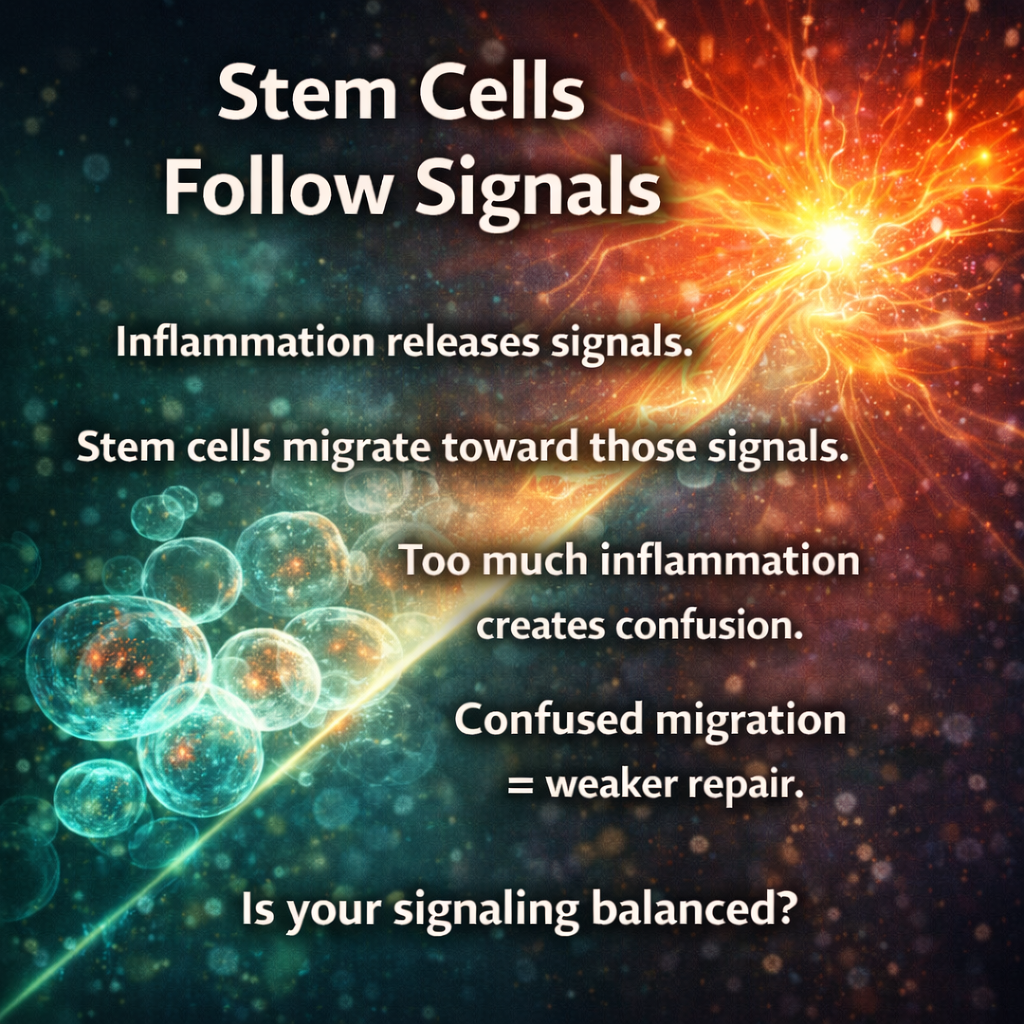
Chronic inflammation increases oxidative stress in the body.
Oxidative stress can degrade nitric oxide before it performs its signaling function.⁴
When nitric oxide availability drops:
- Blood vessels constrict
- Tissue oxygenation decreases
- Stem cell homing efficiency may decline
Think of nitric oxide as a communication amplifier.
If oxidative stress is high, the signal becomes distorted.
Supporting nitric oxide pathways may help improve signal clarity in the regenerative system.
Natural Ways to Support Nitric Oxide Production
The body produces nitric oxide through two primary pathways:
- The L-arginine pathway
- The dietary nitrate pathway
Here are evidence-based strategies to support nitric oxide levels naturally.
1. Nitrate-Rich Vegetables
Leafy greens and beets contain natural nitrates that convert into nitric oxide in the body.
Research in Hypertension shows dietary nitrates improve vascular function and blood pressure markers.⁵
Top sources include:
- Arugula
- Spinach
- Beets
- Swiss chard
2. Regular Exercise
Exercise stimulates endothelial nitric oxide synthase (eNOS) activity.
Even moderate aerobic activity has been shown to improve nitric oxide production.⁶
Movement isn’t just for muscles — it supports vascular signaling.
3. Antioxidant Support
Vitamin C and polyphenols help protect nitric oxide from oxidative breakdown.
Foods rich in antioxidants include:
- Berries
- Green tea
- Dark chocolate (70%+ cacao)
- Citrus fruits
4. Healthy Sleep Patterns
Sleep influences hormonal regulation and vascular tone. Poor sleep has been associated with impaired endothelial function.⁷
The Bigger Regeneration Picture
Stem cells are powerful.
But without proper circulation and signaling support, their efficiency declines.
Nitric oxide supports:
- Vascular dilation
- Cellular signaling
- Oxygen delivery
- Stem cell mobilization
Instead of focusing solely on “increasing stem cells,” the smarter strategy is optimizing the environment that allows them to function.
That includes:
- Reducing inflammatory load
- Improving vascular health
- Supporting nitric oxide pathways
- Prioritizing movement and recovery
Regeneration isn’t about one molecule.
It’s about network optimization.
And nitric oxide is one of the central connectors in that network.
Final Thought
If stem cells are the body’s repair system…
Nitric oxide helps them get where they need to go.
Supporting circulation isn’t just about heart health.
It’s about cellular communication.
And communication determines repair efficiency.
References
Covassin N & Singh P. (2016). “Sleep duration and cardiovascular disease.” Sleep Medicine Clinics.
Moncada S & Higgs A. (1993). “The L-arginine–nitric oxide pathway.” New England Journal of Medicine.
Aicher A et al. (2003). “Essential role of endothelial nitric oxide synthase for mobilization of stem and progenitor cells.” Nature Medicine.
Seals DR et al. (2011). “Endothelial dysfunction with aging.” Circulation Research.
Förstermann U & Sessa WC. (2012). “Nitric oxide synthases.” European Heart Journal.
Webb AJ et al. (2008). “Acute blood pressure lowering by dietary nitrate.” Hypertension.
Green DJ et al. (2017). “Exercise and vascular adaptation.” Journal of Physiology.